 Free Shipping on US Orders $50+
 60-Day Money-Back Guarantee
 Dermatologist-Approved






Photozyme covers peptides in skincare, including how they work, the different types, the evidence supporting them, and how to use them effectively.
Key Takeaways:
- Peptides Signal Skin To Produce More Collagen: Short amino acid chains communicate directly with fibroblasts, stimulating structural protein production through receptor-mediated pathways.
- Different Peptide Types Address Different Skin Concerns: Signal, carrier, neurotransmitter-inhibiting, and enzyme-inhibiting peptides each work through distinct mechanisms targeting different aspects of skin aging.
- Peptides Work Best As Part Of A Layered Routine: Combined with complementary actives like retinol, DNA repair enzymes, and hyaluronic acid, peptides produce compounding improvement that isolated use cannot replicate.
Peptides appear on ingredient lists across dozens of skincare products, but the explanation of what they actually do rarely goes beyond "supports collagen." For an ingredient category with this much clinical support, that description significantly undersells what consistent peptide use delivers.
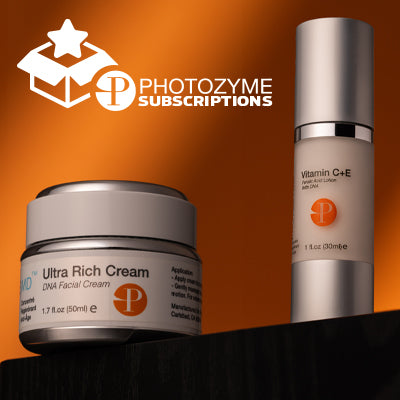
At Photozyme, we formulate with ingredients that address skin aging at the cellular level. Our Ultra Rich DNA Facial Cream and DNA Youth Recovery Facial Serum incorporate active ingredients that support structural skin health, hydration, and cellular repair.
In this article, we’ll break down what peptides in skincare actually are, the different types, what each does, what the evidence shows, and how to incorporate them effectively into a routine.

What Peptides Are And How They Function In Skin
Peptides are among the most misunderstood ingredients in skincare despite having substantial clinical support. Understanding their biology clarifies what they can realistically deliver.
The Basic Biology Of Peptides
Peptides are short chains of amino acids, the same building blocks that form proteins, including collagen, elastin, and keratin. In skin, they function as biological messengers that communicate between cells, signaling specific responses including collagen synthesis, wound repair, and inflammatory modulation.
The American Society for Biochemistry and Molecular Biology, which has advanced scientific understanding of molecular life sciences since 1906 with 11,000 members and a portfolio of peer-reviewed journals covering peptide science and cell signaling, provides the foundational biochemical research base that underlies the clinical application of peptides in topical skincare formulations. Their small molecular size allows them to penetrate the epidermis and reach the dermal layer, where fibroblasts produce the structural proteins that determine skin firmness and resilience.
How Peptides Stimulate Collagen Production
When collagen breaks down through UV exposure, enzymatic degradation, or natural aging, the resulting collagen fragments act as distress signals that trigger fibroblasts to produce replacement collagen. Synthetic peptides mimic these distress signals, activating fibroblast collagen production without requiring actual collagen breakdown to initiate the process. This mechanism produces structural improvements proactively rather than reactively. The Dermatology Foundation, which has invested in groundbreaking dermatology research for nearly 60 years and awarded over $3.6 million in cutaneous biology research funding in 2026 alone, supports scientific investigation into collagen biology, fibroblast activity, and skin aging mechanisms that enable evidence-based peptide use in skincare.
What Peptides Cannot Do?
Peptides do not penetrate as deeply as retinol, do not correct UV-induced DNA mutations, and do not provide the antioxidant protection that vitamin C and ferulic acid deliver. They are one component of a comprehensive anti-aging approach rather than a complete solution. For skin managing significant structural aging, pairing peptides with retinol and DNA repair enzymes produces more comprehensive outcomes than any single active ingredient delivers independently.
Our DNA Youth Recovery Facial Serum delivers three DNA repair enzymes alongside hyaluronic acid and antioxidants; apply it first in the evening on clean skin before any peptide serum, allowing it to absorb fully before layering additional actives, so its DNA repair complex works unimpeded at the cellular level while the peptide layer above it drives collagen signaling.
If you are building a wrinkle-focused routine, our best serum for wrinkles collection is worth browsing for formulation options that combine these mechanisms.
The Different Types Of Peptides And What Each One Does
Peptides for skin benefits vary significantly depending on their structural type and the specific mechanisms by which they interact with skin biology.
Signal Peptides
Signal peptides directly stimulate fibroblasts to increase production of collagen, elastin, and other structural proteins. Palmitoyl pentapeptide-4, commonly known as Matrixyl, is the most studied signal peptide and has demonstrated measurable improvement in wrinkle depth and skin firmness in clinical settings. These peptides are the most directly relevant to structural anti-aging improvement and represent the category with the strongest evidence base for visible results.
Carrier Peptides
Carrier peptides deliver trace minerals, including copper and manganese, to skin cells that require them for enzymatic wound repair and collagen stabilization. Copper peptides are the most widely used in this category, supporting the enzymatic processes that maintain collagen integrity while providing mild anti-inflammatory effects that reduce oxidative stress, thereby accelerating structural degradation.
Neurotransmitter-Inhibiting Peptides
These peptides reduce repetitive muscle contractions that etch expression lines into the skin over time by moderating neurotransmitter signals that trigger them. Argireline is the most commonly used example. Their effect is localized and subtle rather than systemic, producing the most visible benefit in areas of high dynamic movement, such as the forehead and the area around the eyes, when applied consistently over several months.

What The Evidence Actually Says About Peptide Results
What peptides do for skin in controlled settings versus in marketing contexts is a meaningful distinction worth examining honestly.
What Clinical Studies Show
Multiple peer-reviewed studies on signal peptides, including palmitoyl pentapeptide-4 and palmitoyl tripeptide-1, demonstrate statistically significant improvements in wrinkle depth, skin firmness, and collagen density over eight to twelve weeks of consistent use. The European Academy of Dermatology and Venereology, with over 9,000 members worldwide since 1987, promotes evidence-based dermatological practice and hosts scientific sessions that specifically examine topical actives, including peptides, providing one of the major international forums through which clinical research on peptide efficacy is evaluated and disseminated among dermatologists. These studies use controlled conditions and validated measurement tools, yielding results that reflect genuine biological change rather than temporary surface effects from hydration or barrier-support ingredients within the same formulation.
How Peptide Results Compare To Retinol
Retinol produces faster and more pronounced structural improvement than peptides at equivalent timelines, but peptides produce meaningful improvement with significantly less irritation risk. For skin that cannot tolerate retinol or is gradually building tolerance, peptides provide collagen-stimulating benefits through a complementary pathway that does not compete with retinol's mechanism when used together. Browsing the best serums for aging skin collection is a practical next step for those looking to combine peptides with other structural actives in a single routine.
How To Use Peptides Effectively In A Skincare Routine
Skincare peptides explained in isolation matter less than understanding how to position them within a complete routine where their mechanisms compound with complementary actives.
Where Peptides Belong In The Routine
Apply peptide-containing serums after cleansing and before moisturizer, in either the morning or evening routine. Unlike retinol, peptides do not require strict evening-only use and can be used at any time, depending on your routine. Our Ultra Rich DNA Facial Cream provides ceramides, antioxidants, and DNA repair enzymes as a sealing moisturizer layer that complements the application of a peptide serum in the evening routine. Its occlusive finish locks in the peptide layer without disrupting its signaling activity, while ceramides support the barrier function that consistent retinol and peptide use can temporarily challenge over time
Pairing Peptides With Complementary Actives
Peptides pair well with hyaluronic acid, DNA repair enzymes, ceramides, and antioxidants without the pH conflicts or timing restrictions that retinol and vitamin C require. For anti-aging routines that combine multiple mechanisms, peptides in the morning routine alongside vitamin C and SPF, and retinol in the evening alongside DNA repair enzymes, produce compounding structural improvements across both treatment windows. Our Vitamin CE + Ferulic Acid Lotion fits the morning antioxidant layer: apply it after your peptide serum has absorbed and before SPF, where its vitamin C, vitamin E, and ferulic acid complex amplifies UV defense and addresses oxidative aging while the peptides work on collagen signaling beneath it. The Night Skincare Routine and Dermatologist-Recommended Hyaluronic Acid Serums guide provides practical frameworks for building this layered approach.
Consistency Determines Peptide Outcomes
Peptide results develop over eight to twelve weeks of uninterrupted daily use. The collagen synthesis they stimulate is a biological process that requires sustained signaling rather than periodic intensive application. Introducing peptides and then rotating them out of the routine before the twelve-week mark prevents the compounding structural improvement that consistent use produces over time. Those managing periorbital aging alongside broader facial concerns may also find value in exploring the best targeted anti-aging eye cream options that incorporate peptides as part of a focused under-eye routine.

Final Thoughts
Peptides are among the most well-tolerated and consistently supported ingredient categories in skincare, delivering structural collagen improvements through biological signaling pathways that complement rather than duplicate what retinol, antioxidants, and DNA repair enzymes each contribute to the same routine.
At Photozyme, our approach to skin aging addresses multiple mechanisms simultaneously. Our DNA Youth Recovery Facial Serum and Ultra Rich DNA Facial Cream incorporate active ingredients designed to support structural skin health, cellular repair, and barrier integrity, and their effectiveness compounds with consistent use.
If your anti-aging routine is missing a low-irritation, collagen-supporting active, peptides are a practical, evidence-backed option to add.
Frequently Asked Questions About Peptides In Skincare
Do peptides work for all skin types?
Yes. Peptides are well-tolerated across all skin types, including sensitive and reactive skin that cannot consistently tolerate retinol or strong exfoliating acids.
Can peptides be used during pregnancy?
Peptides are generally considered safe during pregnancy, but consulting a healthcare provider before introducing new actives during this period is always advisable.
Do peptides help with dark spots or hyperpigmentation?
Not directly. Peptides address structural aging rather than pigmentation. Vitamin C and DNA repair enzymes are more appropriate actives for tone-evening and pigmentation concerns.
How do peptides interact with retinol in the same routine?
Peptides and retinol work through complementary mechanisms without pH conflict. Apply peptides before retinol in the evening routine, and apply retinol only after the skin has completely dried.
What makes the Ultra Rich DNA Facial Cream suitable for use alongside peptide serums?
It provides ceramides, antioxidants, and DNA repair enzymes as a sealing moisturizer layer that supports barrier function after applying the peptide serum in the evening routine.
Are more expensive peptide products more effective?
Not necessarily. Efficacy depends on the specific peptides included, their concentrations, and formulation stability, rather than price point or packaging presentation.


